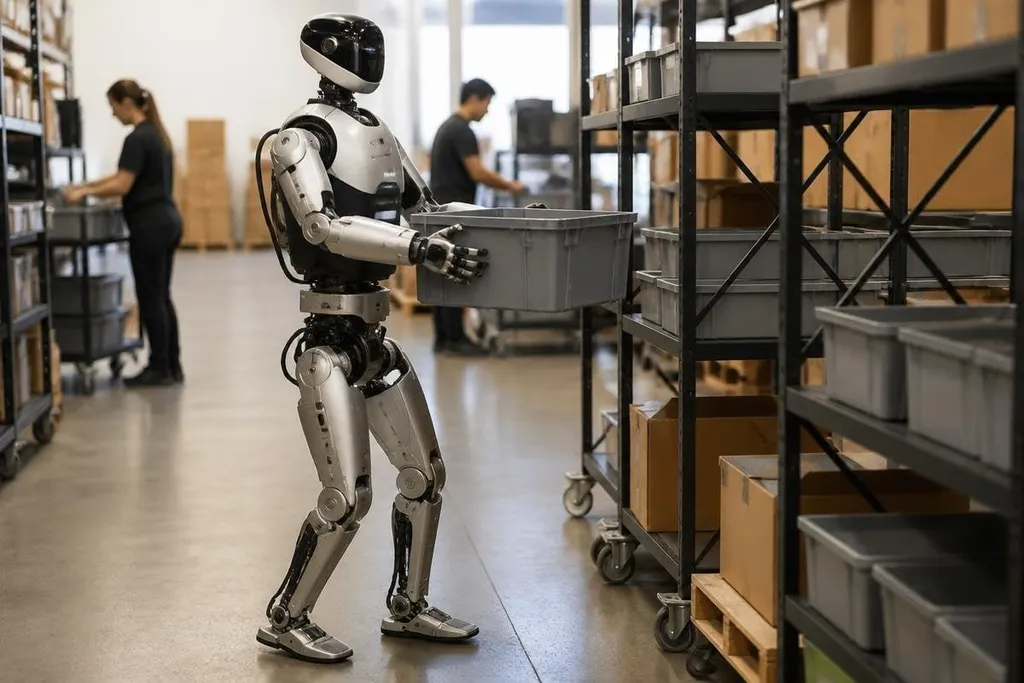
A humanoid robot can look ready for work long before it can repeat one task for a full shift. For buyers, the useful question is not which company has the loudest demo. It is which machine has proof for the job you need done.
- Payload, runtime, and task speed decide whether a robot can work.
- A staged demo says less than a repeatable task record.
- The missing number is often the cost of running the robot each day.
What “better” needs to mean
A better humanoid robot needs a clear job and a measured result. For warehouse work, one that carries boxes may need enough payload, steady balance, safe stops, and a battery that lasts through the planned work period.
Research systems may need open software, sensor access, and a way to record each trial.
That makes broad rankings weak. A robot can walk well and still struggle with a gripper that cannot hold a soft package. Another can lift more weight but need a remote operator for most of the task. The comparison changes with the work.
For a warehouse manager, ask for the task record rather than the stage video. The useful details include the object weight, cycle time, number of failed attempts, operator input, floor type, and lighting. Without those details, a success rate has little value.
The numbers that matter
A serious comparison starts with a short set of measurements. Each number answers a cost or safety question for the person buying the system.
Payload tells you what the robot can carry in the stated posture. Reach shows whether it can work inside a shelf, bin, or vehicle. Runtime gives the length of a work period before charging or a battery change. Cycle time shows how many completed tasks fit into an hour.
Recovery matters too. If the robot falls, loses its grip, or sees an object in the wrong place, how long does it take to return to work? A system that needs a technician after every error may cost more to run than its purchase price suggests.
Safety data needs the same care. Ask which sensors stop motion, how the stop behaves near a person, and what testing supports the claim. A safety label without a test method leaves the buyer guessing.
Demos are useful, but incomplete
A demo can show that a robot has performed a task. It does not show how often the task works, how much human help sits outside the frame, or what happens after a small error.
Robot makers should publish repeat counts, failure types, recovery time, and operator minutes per task. Video length also matters. An uncut sequence gives more useful evidence than a set of short clips joined after the successful attempts.
The robot, task, date, and result should sit beside any company claim. Robotics reports from Robot24.com give you that context before you judge how much of the task still needs a person.
The same rule applies to claims about artificial intelligence. Ask which parts run without a person, which tasks use teleoperation, and what happens when the robot meets an object outside its training data. “Autonomous” needs a task boundary and a failure record.
The cost behind the robot
The purchase price is only one line. A buyer also needs the cost of batteries, spare parts, software, training, network service, safety checks, and human supervision. Those costs depend on the model and the work site, so they need a written quote.
Availability matters as well. A research unit, a pilot fleet, and a robot you can order for regular use are different products from a buyer’s point of view. Ask for the delivery date, support location, warranty terms, and the parts that the maker keeps in stock.
I’d judge a humanoid robot by its repeatable work record, not by how naturally it walks.
A buyer’s check before a pilot
Use this list before signing a trial agreement:
- Define one task, its object weight, and the required cycle time.
- Ask for an uncut video and the full trial record.
- Record operator minutes for normal work and recovery from errors.
- Price batteries, service, software, training, and spare parts separately.
- Set a pass rate and a date for reviewing the results.
- State who pays when the robot stops or damages a product.
A pilot should end with a number that decides the next step. If the robot cannot meet the agreed task rate with the agreed level of human help, the project needs a new design or a different machine.